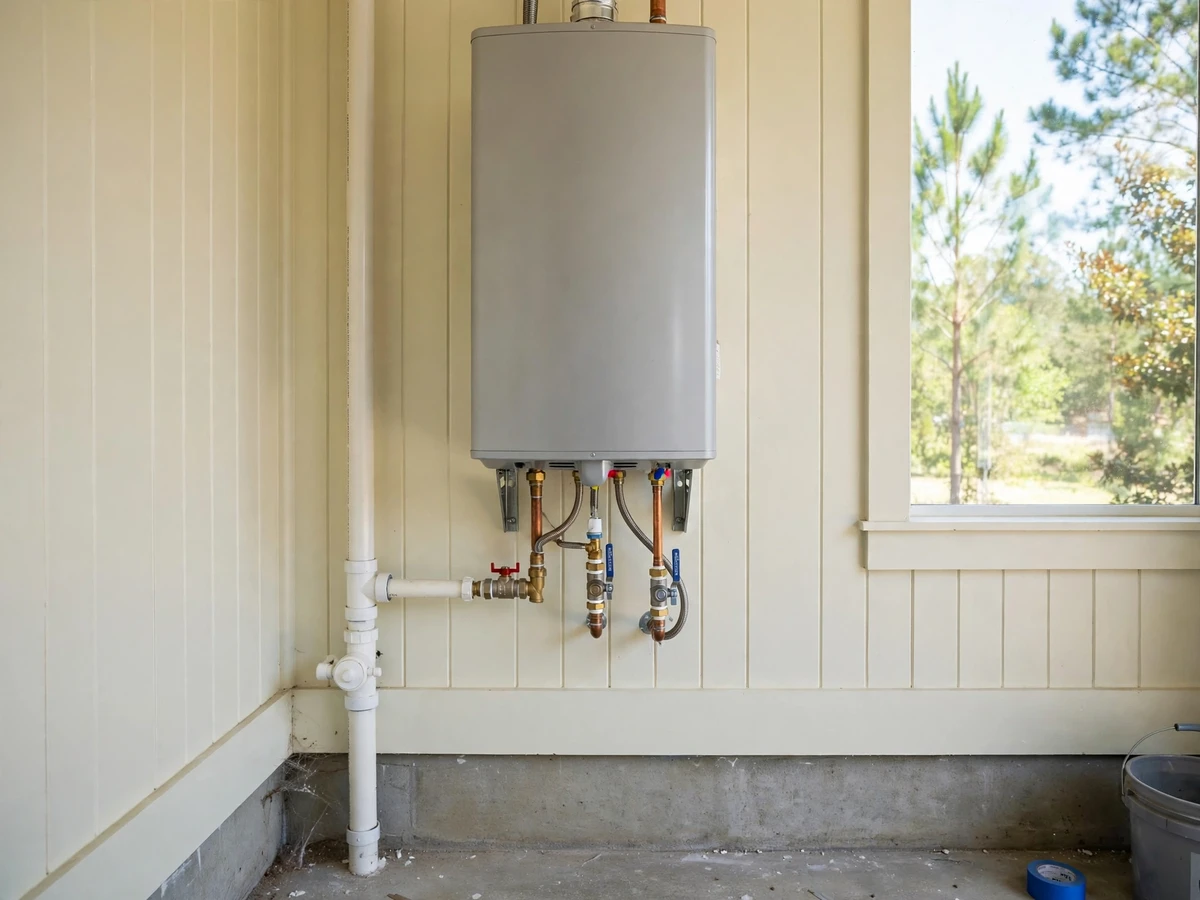
This is a genuine decision, not just an upsell. The right answer depends more on your household's actual hot water demand than on which option sounds more modern. It's worth working through the real numbers, upfront cost, expected lifespan. Maintenance, before committing either way rather than choosing based on which option a salesperson happens to prefer that day.
A tank water heater costs less upfront ($1,400 to $2,600 installed for a standard 40-50 gallon unit) and is generally simple to service. Its real limitation is capacity: once the tank runs out, you wait for it to reheat, which matters in a household running multiple showers, a dishwasher, and laundry close together.
A tankless unit costs more upfront ($2,800 to $4,200 installed) but heats water on demand rather than storing a fixed amount, meaning it genuinely does not run out, provided it is sized correctly for the home's simultaneous demand.
Sizing is where tankless most often goes wrong. An undersized unit does not just run slower, it genuinely cannot keep up with two showers and a dishwasher running at once. That failure shows up as a real capacity problem, not an occasional inconvenience. Sizing to the home's real fixture count and typical simultaneous use matters more than a generic square-footage estimate.
The math tends to favor tankless most clearly in larger households with high simultaneous hot water demand, common in the bigger homes going up around Towne Lake and Holly Springs. Favors a standard tank in a smaller household or a smaller downtown home where the tank rarely runs dry anyway. Neither choice is objectively better in the abstract. The right one depends entirely on how your specific household actually uses hot water day to day.
Operating cost is a real, if secondary, factor worth including in the decision. A tankless unit only heats water when it's actually being drawn, avoiding the standby heat loss a tank experiences continuously keeping stored water hot, which can translate into a modest but real energy savings over the unit's lifespan.
Retrofit cost is another practical consideration many homeowners underestimate. Converting an existing gas tank installation to gas tankless sometimes requires a larger gas line and a dedicated vent the original tank never needed. That adds to the upfront installation cost beyond just the unit price difference between the two options.
Maintenance expectations differ too, and it's worth factoring in honestly. A tank needs an occasional flush but is otherwise low-maintenance for its whole service life. A tankless unit needs periodic descaling, roughly every 12 to 18 months in this region's water, to perform at its rated capacity. Skipping that maintenance is the single most common reason a tankless owner ends up disappointed with a system that was correctly sized in the first place.
Space savings are a real, if secondary, factor for some homeowners. A tankless unit mounts on a wall and takes up a fraction of the floor space a standard 40-to-50-gallon tank requires. That can matter in a smaller mechanical closet or a home converting a former water heater closet into usable storage.
It's worth having a real conversation about future plans too. A household that expects to grow may want to size any new water heater with that future demand in mind. Think of an addition, a finished basement bathroom, or a growing family. Sizing ahead beats replacing again in a few years once the household's real needs change.
Neither option is inherently the "right" answer for every home. Being skeptical of a contractor who pushes one option hard regardless of your household's actual situation is reasonable. A genuinely honest recommendation should follow from your specific fixture count, household size. Hot water habits, not a standard upsell script applied to every customer.
Safety Steps Before You Replace A Water Heater
- If you smell gas, leave the house first, then call 911 and your gas utility from outside.
- If the tank is leaking, close the cold water supply valve above it and turn off the power or gas to the unit.
- Do not tamper with the temperature and pressure relief valve.
- Write down the model, size, and fuel type of the old unit. It speeds up the quote.
- Call us before removing anything so we can plan the swap and the venting.
Permits And Venting When You Switch To Tankless
Switching from a tank to a tankless unit can change gas line size, venting, and electrical needs. Ask the City of Woodstock Building & Safety Division or the permitting office for your address whether the change needs a permit.
Newer builds around Towne Lake and Kennesaw and older homes near downtown can differ a lot in venting and gas supply. We look at both during a visit before recommending either type.
Common Questions
How long does a tankless water heater last compared to a tank?
A well-maintained tankless unit often lasts 15 to 20 years, compared to 8 to 12 for a standard tank, though that assumes regular descaling. A neglected tankless unit in hard water can fail well short of that range.
Can I install a tankless water heater in an older downtown Woodstock home?
Usually yes, but expect a real conversation about gas line sizing and venting requirements first. Older homes weren't built with tankless installation in mind the way newer construction increasingly is.
Do I need a bigger tankless unit if I want two showers running at once?
Yes, sizing has to account for simultaneous demand, not just peak single-fixture flow. A unit sized only for one shower will genuinely struggle, or fail to keep up, when a second fixture draws hot water at the same time.
Does switching to tankless need a permit in Woodstock?
It may, because the change can involve gas, venting, and electrical work. Ask the permitting office for your address, and we can confirm what applies before work starts.
What This Means For You
If you are replacing a failed unit under time pressure, a like-for-like tank swap is usually the fastest same-day option. If you have time to plan ahead of a failure, it is worth a real conversation about your household's actual hot water use before deciding. Either path is reasonable. The goal is simply making the choice deliberately rather than defaulting to whatever the last homeowner happened to have installed.
We walk through this decision honestly during any water heater replacement estimate. If you already have a tankless unit underperforming, check our tankless service page first. It is often a maintenance fix, not a sizing problem. That kind of on-site judgment call is exactly why we assess in person before quoting a fix.
Larger homes in Towne Lake are some of the strongest tankless candidates we see, simply due to household size and simultaneous demand. Reach out and we can confirm your exact service area on the call.