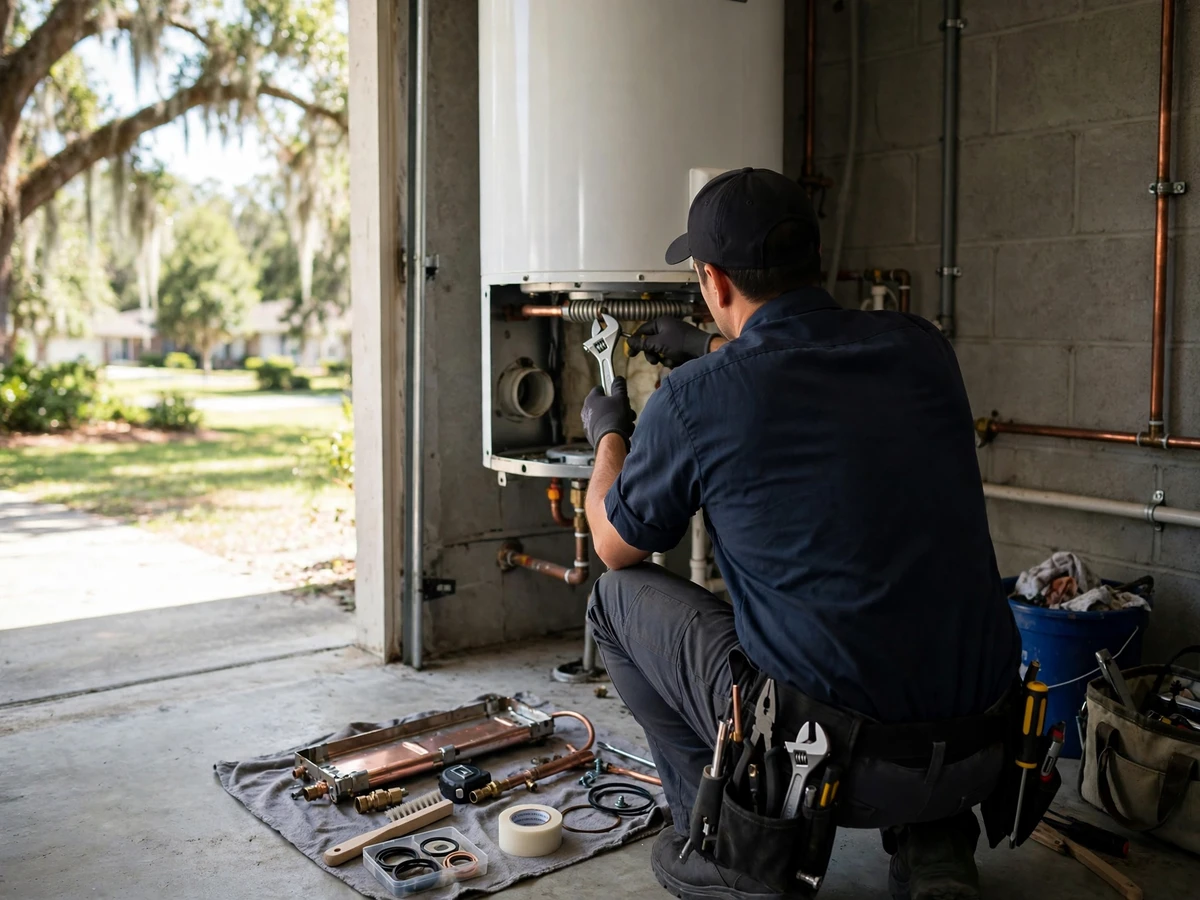
Emergency Water Heater Repair: Leaking Or No Hot Water
A leaking tank, water pooling around the base, or a heater that has stopped making hot water is a reason to call our emergency line. Turn off the power or gas to the unit, close the cold water valve above it, and keep the area clear.
We respond around the clock, find where the water is coming from. Tell you right away whether a repair or a replacement is the sensible fix. If it can be fixed the same visit, we do it.
Electric tank water heaters most often fail at the upper or lower heating element or the thermostat controlling it, which shows up as lukewarm water, water that runs out faster than it used to, or a tank that trips its breaker repeatedly. Both are straightforward, inexpensive repairs compared to a full replacement.
Gas tank units more often develop pilot light or thermocouple problems, where the pilot will not stay lit or the burner will not ignite even though gas is reaching the unit. That is a repair, not a replacement, in the large majority of cases we see.
A pressure relief valve venting water is not a leak to panic over. It is the safety valve doing exactly what it is designed to do when tank pressure gets too high, usually from a temperature setting that is too high or a buildup of sediment restricting normal pressure release. We check the setting and flush the tank before assuming the valve itself has failed.
The real decision point is age. A unit under 6 to 8 years old with a single failed part is almost always worth repairing. A unit past 10 years with a failed part, especially if there is any rust at the base, is usually more honestly served by a full water heater replacement rather than a repair that buys a few more months.
Most tank manufacturers offer a 6 to 12 year warranty on the tank itself. But that warranty typically covers the part, not the labor to diagnose and install it. It requires the original proof of purchase and, on some models, proof of annual maintenance. We check for an active warranty before quoting a repair, since it sometimes changes the real out-of-pocket cost significantly.
If a repair visit turns up a tank that is corroding from the inside rather than a fixable part, we will say so plainly and walk through replacement options and real costs before doing any work.
A water heater that keeps tripping its breaker alongside other electrical oddities in the house is occasionally a wiring issue rather than the unit itself, which is outside plumbing scope, and we will tell you when a repair call is actually pointing at that instead.
We repair both tank and tankless units throughout Woodstock and into Hickory Flat the same day for most calls.
Repair or replace looks different across Woodstock. In the 1990s sections of Towne Lake Hills and Eagle Watch an original unit is usually past repair economics. Meanwhile, a 7 to 10 year old tank in a newer neighborhood such as Weatherstone or Bradshaw Farm is often worth fixing. Give us the subdivision name and the age printed on the label and we can usually tell you which way it leans before we arrive.
What To Check Before We Arrive
Gas smell near the water heater
Do not attempt to relight a gas water heater's pilot if you smell gas anywhere near it. Leave the house, call the gas utility from outside. Only call us once the gas company confirms it is safe to go back in.
Water pooling at the base
Water at the base of the tank itself, not a nearby fitting, usually means the tank is corroding from the inside and cannot be patched. Shut off the water supply to the tank and the power or gas to the unit until a technician arrives.
Breaker keeps tripping
An electric water heater that trips its breaker repeatedly should stay off rather than being reset again and again. Repeated tripping is the breaker doing its job to prevent a bigger electrical problem.
What It Typically Costs
| Service | Typical Range |
|---|---|
| Heating Element or Thermostat Replacement | $180 to $380 |
| Pilot Assembly / Thermocouple Repair | $150 to $350 |
| Tank Flush & Sediment Service | $120 to $220 |
We give a written quote before non-emergency work begins. Emergency dispatch carries a standard trip charge disclosed on the call. Want a real number for your situation? Call (770) 214-4545.
Water Heater Leaking? What We Check First
A leaking water heater is the call we hear most urgently, because a small drip can become a flooded closet or garage quickly. The first thing we do is find where the water is coming from. A leak at a fitting, a drain valve, the relief valve discharge, or a supply connection is often repairable. Water seeping from the bottom of the tank itself usually means the tank has failed.
If you see water, shut off the cold supply valve above the heater and turn the power or gas to the unit off. If the leak is active, call right away and move anything stored near the heater out of the water's path.
We will tell you plainly whether the leak is a repair or a replacement. A fitting we can fix the same visit is a very different bill from a tank that has rusted through. You should know which one you have before any work starts.
Frequently Asked Questions
My water heater is leaking. Is that a repair or do I need a new one?
Water leaking from a fitting or connection is usually a repair. Water leaking from the tank body itself means the tank has corroded from the inside and needs full replacement, since a corroded tank cannot be patched.
Why does my water heater smell like rotten eggs?
That smell usually comes from bacteria reacting with the magnesium anode rod inside the tank, particularly in well water. It's a repair (replacing the anode rod and flushing the tank), not a sign the unit is failing.
How do I know if it's worth repairing versus replacing?
Age is the main factor. A unit under 8 years old with one failed part is almost always worth repairing. A unit over 10 years old, especially with any rust at the base, usually costs more in repeated repairs than a straightforward replacement would.