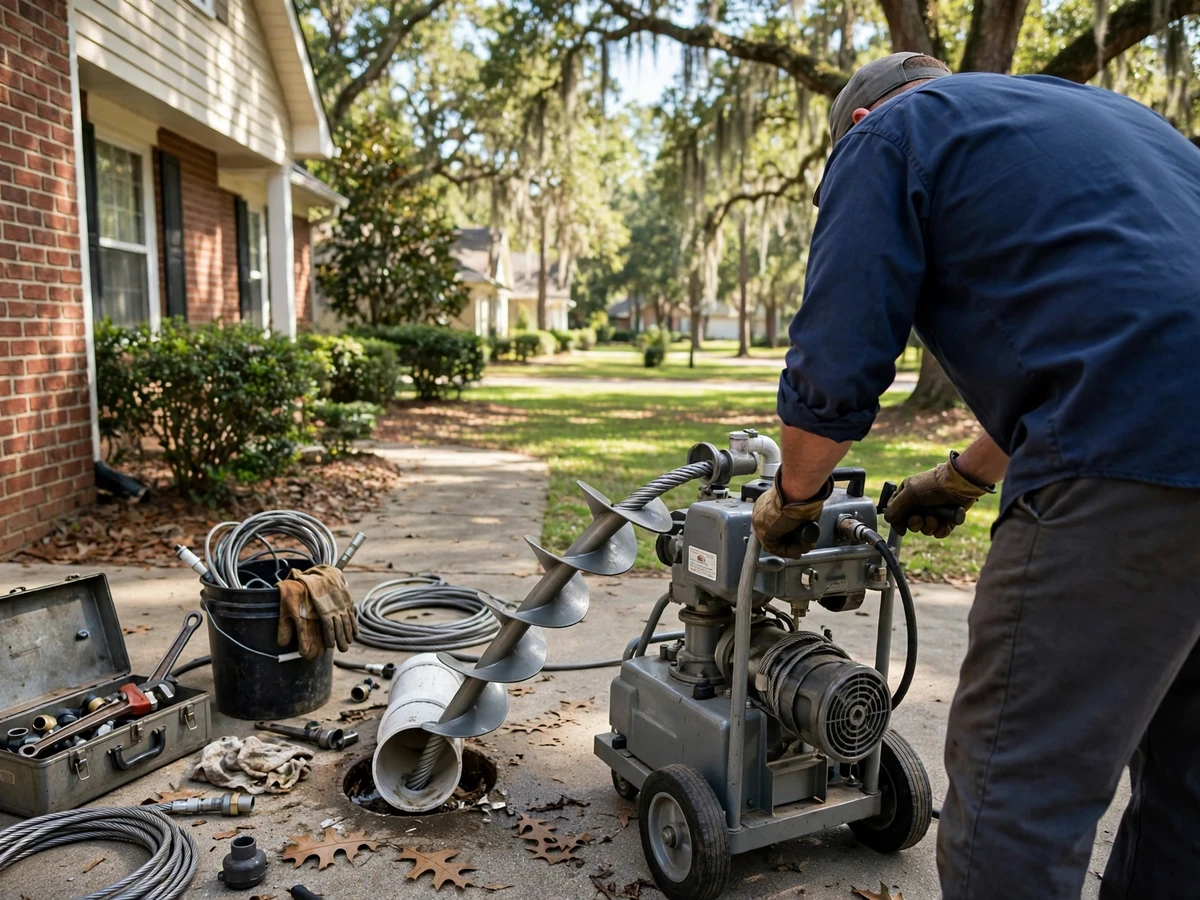
Emergency Drain Cleaning: Backups And Overflows
A drain that has stopped completely, a toilet or tub backing up, or water coming up in a floor drain needs attention now. Stop using water in the home, keep children and pets away from standing water, and call our 24/7 emergency line.
Our emergency drain cleaning crews arrive with cables and jetting equipment so the line can be cleared on the first visit when possible. If a camera shows a larger problem, we explain it before recommending any repair.
Homes built before the 2000s boom, concentrated in the blocks around Main Street and the older sections east of downtown, are more likely to still have original cast iron drain lines. Cast iron corrodes and narrows from the inside over decades. A kitchen or bathroom drain that has "always been a little slow" in one of those homes is usually a pipe-condition issue, not just grease buildup.
Newer PVC drain lines in the Towne Lake-area subdivisions clog for different reasons, mostly grease, wipes. Hair rather than corrosion, and usually respond well to standard cabling. We bring both cabling and hydro jetting equipment to every drain call so the technician can match the tool to the actual pipe material once they see it, rather than guessing over the phone.
Root intrusion is the other major driver of drain and sewer backups in this county. Mature tree cover is common throughout Cherokee County's older neighborhoods and roots find their way into pipe joints over time. If a drain backs up repeatedly in the same spot every few months, that pattern usually points to roots rather than a one-time clog. It is worth saying so when you call.
A single backed-up drain is a drain cleaning call. Multiple fixtures backing up at once, especially the lowest drain in the house, is usually a main line problem and gets treated differently. It can mean sewage is backing up rather than just one clogged fixture.
A short list of real prevention habits makes a measurable difference regardless of pipe material. Never pour grease down a kitchen drain, because it solidifies as it cools and narrows the pipe over time. Avoid flushing wipes even when a package says "flushable" They do not break down like toilet paper and are a leading cause of both drain and sewer clogs. Run hot water after any garbage disposal use to help carry debris through rather than letting it settle in the line.
A drain that gurgles when a different fixture is used, for example a toilet gurgling when the washing machine drains, is a sign of a venting or main-line issue rather than a simple local clog. It means air is being pulled through the plumbing system in a way it should not be. That symptom is worth mentioning when you call, since it changes what a technician checks first.
If cabling and jetting clear the line but the same drain slows down again within a few weeks, the next step is usually a camera-based inspection to rule out a structural pipe issue rather than repeating the same fix.
A main line backup that reaches multiple fixtures at once is sometimes actually a sewer line problem rather than a simple clog. We will say so rather than billing for repeated drain cleaning visits on the same root cause.
The cast-iron-heavy blocks near downtown generate a disproportionate share of these calls compared to newer construction toward Holly Springs.
Mature landscaping in Towne Lake Hills and Wyngate. Along the older streets around Main Street in downtown Woodstock, is where root-related backups are most likely, compared with the newer builds along Towne Lake Parkway and in Bradshaw Farm. If the same drain backs up again after cabling, tell us the neighborhood and we will start with a camera.
What It Typically Costs
| Service | Typical Range |
|---|---|
| Standard Drain Cabling | $150 to $350 |
| Hydro Jetting | $350 to $650 |
| Main Line Clearing | $300 to $600 |
We give a written quote before non-emergency work begins. Emergency dispatch carries a standard trip charge disclosed on the call. Want a real number for your situation? Call (770) 214-4545.
Kitchen Sinks, Showers, And Tubs
Kitchen sink clogs are usually grease, food residue, and soap film that has built up inside the trap and the first section of line. A slow shower or tub drain is more often hair and soap that collects just past the strainer. Both are fixed differently from a main line backup, so we start by asking which fixtures are affected.
If only one sink is slow, the blockage is almost always in that fixture's own branch line. If several drains gurgle or back up together, the problem is further down the system and needs a longer cable or a camera. That quick question saves time, because it tells us which tool to bring in from the truck.
Cabling, Snaking, And When To Step Up To Jetting
Cabling, which many people call snaking, pushes a rotating cable through the clog and either breaks it up or pulls it out. It is the right tool for most single-fixture stoppages and for a first pass on a main line. Hydro jetting uses high-pressure water to scour the pipe wall and is the better answer for grease and roots that keep coming back.
We will tell you which one fits before we start. If a cable clears the line but the drain slows again within weeks, that is usually the sign the pipe walls are coated and jetting or a camera inspection is the next step.
Floor drains, trench drains, and driveway culvert pipes get the same treatment. A grate that needs to come off or a drain that has silted up from yard runoff is a different clog from a bathroom stoppage, and we plan for it differently.
Frequently Asked Questions
What's the difference between cabling and hydro jetting?
Cabling physically breaks through a clog with a rotating cable and is usually enough for hair, grease, and soft blockages. Hydro jetting uses high-pressure water to scour the full diameter of the pipe, which works better on root intrusion and long-term buildup that cabling only punches a hole through.
Why does my drain keep clogging in the same spot?
A drain that clogs repeatedly in the same location, rather than a one-time clog, usually means a structural issue, most often root intrusion or a pipe with a low spot (a "belly") where waste collects instead of flowing through. That calls for a camera inspection rather than repeated cabling of the same symptom.
Is a slow drain worth calling about, or should I wait until it's fully clogged?
A slow drain in an older cast iron line is worth addressing before it fully clogs. The corrosion causing the slowdown does not reverse itself, and a full backup is more likely to happen at an inconvenient time.